NOTE: Copying or republishing of this article is encouraged but only if it includes the title and names of both authors and a link to the article: https://www.trickedbythelight.com/tbtl/Sovereign-Consciousness-Principle.html
An audio/video version of this article can be found here: YouTube video
We do not claim to know for certain what happens after death.
Sovereign Consciousness Principle (SCP) does not try to prove or disprove any religious or metaphysical claim. Instead, it offers a practical way to think about decisions when certainty can’t be verified.
This article is for two groups: people who are new to these topics and people who are already familiar but want a solid backup plan for making decisions in uncertain situations.
What's presented in this article is not meant to replace our plan of action at death. Unlike some of our other content, this piece steps back from specific metaphysical interpretations and case studies—like near-death experiences or out-of-body experiences—and focuses instead on a more neutral, practical approach.
For a more detailed afterlife strategy, you can also check out our Afterlife Affirmation and Solutions article. Links are at the bottom.
If you already feel certain about what happens after death, this approach may not pertain to you. SCP is meant for situations where certainty is missing, unclear, or incomplete.
People have been asking the same fundamental questions for thousands of years. Is there a God? What is our true essence? Where did we come from? What happens after death? What’s the meaning of existence?
The Sovereign Consciousness Principle doesn’t try to answer those questions.
Instead, it focuses on something more practical. If we don’t know for certain the nature of our true essence or the ultimate nature of reality, what is the most reasonable way to make decisions?
That question becomes important, especially after death, where understanding may be limited and the consequences of a decision could be severe.
SCP begins with a basic observation. In experience, choices seem to matter and life unfolds as if personal decisions have meaning.
Because we don’t know which explanation of reality is correct, SCP is designed to work across every possibility. It doesn’t depend on any single belief system, philosophy, or theory.
Rather than trying to explain reality, it focuses on how to navigate through it when knowledge is incomplete or things are unclear. Preserving your ability to choose is less risky than prematurely choosing before things are clear.
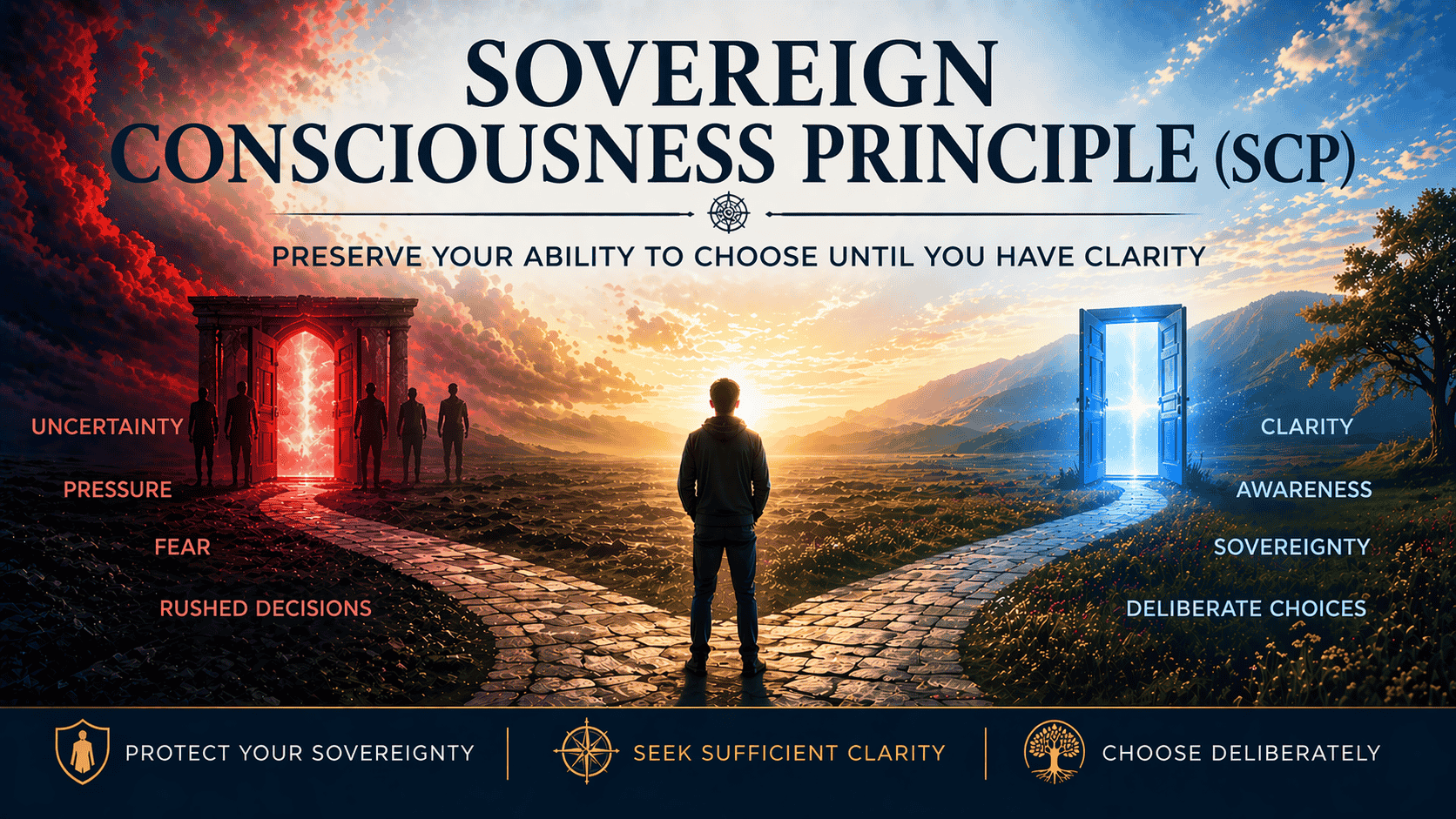
So, the core idea of SCP is: Maintain your ability to choose until you have clarity.
Clarity, in this context, doesn’t mean knowing everything. It is having enough understanding to make a decision without being influenced by pressure, fear, or confusion.
We find ourselves conscious in a reality we do not recall choosing, do not remember entering, and do not fully understand.
We arrive without prior knowledge and without any clear explanation for where consciousness comes from, why it exists, or what ultimately happens after death. Our beliefs about these questions are shaped by culture, religion, philosophy, and personal interpretation, yet there remains no consensus regarding the answers.
In other words, our current existence begins and remains in uncertainty.
That uncertainty becomes especially important at the moment of death. At that time, decisions may need to be made under conditions that are unclear, unfamiliar, or difficult to interpret.
Although reports from near-death experiences (NDEs) and out-of-body experiences (OBEs) suggest that awareness, memory, or clarity will function the same way as they do here, SCP does not assume that. That uncertainty is part of the reason a cautious approach is emphasized.
Choices made under confusion, pressure, or incomplete knowledge could potentially lead to consequences that may be difficult, or even impossible, to reverse. While this can’t be known with certainty, some reports suggest this may be the case. These may include coerced participation without full understanding, loss of autonomy, suppression of memory, or unwanted cycles of reincarnation.
In recent decades, reports from NDEs, OBEs, and other altered states have added more to consider. These accounts describe a wide range of situations, including encounters with self-proclaimed or assumed authority figures, emotional persuasion, urgency, disorientation, and memory disruption.
These are the same conditions psychologists identify as making people highly vulnerable to influence and manipulation.
This doesn’t mean those experiences are false, deceptive, or harmful. But it does raise an important concern. Important decisions might be made under conditions where clarity is limited and pressure is high.
At its core, SCP puts sovereignty first.
When you don’t understand the situation, don’t give up your ability to choose.
Instead, wait. Wait until things become clear.
When the environment is unknown, claims of authority cannot be verified, the intentions of others are unclear, and the consequences of your choices are not understood, preserve the ability to choose and do not give consent until clarity has been reached.
This isn’t about rejecting connection or interaction altogether. You can still interact, participate, explore, and form relationships. Those choices are up to each individual. But SCP does not assume that interaction is safe by default. In unclear situations, the priority is preserving your ability to choose and avoiding commitment or agreement until sufficient clarity has been reached.
The concern behind SCP is straightforward. If a decision is made without enough clarity, especially after death, it could have lasting consequences. While this can’t be known with certainty, some reports suggest that certain choices may limit or influence what options are available afterward. In some interpretations, this could even include losing the ability to choose freely.
At stake is the ability to accept, refuse, or delay participation, especially when authority is claimed or obligations are assumed. This is not about assuming the worst, but about recognizing that uncertainty exists and acting carefully within it.
SCP is for those who believe that individual choice and consent are meaningful. If reality were ultimately governed by a single overriding will or if all consciousness inevitably dissolves into a single source where individual choice disappears, then the concept of sovereignty would have little meaning.
If individual choice matters, then protecting it is important.
Nearly every religious or belief system fails at the moment of death. These systems encourage trust or surrender based on faith when uncertainty is at its highest and verification may be impossible.
Some encourage submission to a higher power or authority, such as a god or spiritual guide. Others encourage returning to a universal source or dissolving into a larger unity. Still others assume that consciousness continues through cycles of reincarnation.
If these systems are correct and benevolent, they may pose little risk. But if they are incomplete, misunderstood, or incorrect, then giving up your ability to choose too quickly could have serious consequences. Some reports suggest that certain choices may limit or influence what options are available afterward. In some accounts, this includes being drawn into cycles of experience, such as reincarnation, without full clarity.
SCP is helpful because while some traditions address post-death awareness or deception, few focus explicitly on preserving sovereignty under uncertainty.
This leads to an important question: Why do people feel confident trusting or surrendering under conditions of uncertainty?
Experience vs Interpretation
There is a difference between what is real, what we experience, and what we think that experience means. These often get mixed together. When something feels powerful or meaningful, it’s natural to assume that our interpretation must be true.
But similar experiences are often explained in very different ways depending on a person’s beliefs or background. People may describe encounters with beings, light, or unity, while explaining them through completely different belief systems.
That suggests something important. The experience itself may be genuine, while its interpretation remains uncertain.
SCP therefore respects experiential reports while remaining cautious about conclusions drawn from them.
Why Powerful Experiences Can Mislead
This becomes even more complicated with intense experiences. Some people describe certain states as feeling “more real than real.” That intensity can create a strong sense of certainty, which we call experiential certainty bias.
This can happen in a few different ways. It may be driven by emotional intensity, such as overwhelming feelings of love, peace, or belonging. It may be driven by cognitive intensity, such as sudden insight, apparent knowledge, or what feels like a complete or strong sense of understanding.
In both cases, the strength of a feeling is not proof that the interpretation of an experience is correct.
For this reason, powerful experiences should be balanced with careful reasoning and critical reflection before drawing conclusions.
There is also a common pitfall here: Experiences can feel most convincing at the same time they are hardest to verify. In everyday life, we can often check or confirm what is happening. In altered or unfamiliar states, that becomes much more difficult, even as the experience itself feels more certain.
Because of this, it helps to separate how something feels from how well it can be examined.
A strong or meaningful experience is not necessarily wrong, but it is not automatically reliable either. What feels true still needs to be understood, tested, and observed over time when possible.
SCP therefore does not recommend reacting immediately to intense experiences. Instead, it suggests allowing time for things to settle, maintaining the ability to question what is occurring, and observing whether the experience remains consistent.
If similar patterns occur in non-physical or altered states during life, they may also occur during major transitions, including death.
For this reason, SCP recommends preserving awareness and withholding agreement until clarity becomes possible.
We don’t know for certain the nature of our true essence. SCP does not depend on that knowledge. We know that awareness and conscious experience are present.
SCP does not define what awareness and consciousness ultimately are. It does recognize that experience appears to involve awareness and the capacity for decision-making.
For SCP:
Awareness is treated as the most basic condition that makes experience possible. It is simple presence, prior to form, memory, or identity. It is the capacity to experience anything at all.
Experience is whatever is present in awareness—sensations, thoughts, emotions, perceptions, and memories.
Consciousness is treated as something that appears with experience. It is how everything you experience comes together as you. This includes perception, attention, memory, emotion, thought, interaction, identity, and decision-making. Consciousness is what allows things to be experienced, understood, and responded to in different ways.
A simple way to think about it is this: Awareness is like the ability to see, while consciousness is what appears in that view.
SCP doesn’t attempt to define what we ultimately are. That question remains open.
The key point of SCP is that wherever experience involves decision-making, the question of sovereignty becomes relevant.
When people hear the word sovereignty, they usually think of kings, governments, or political power. The Merriam-Webster definition of sovereignty includes having independent authority and the right to govern oneself. It does not require unlimited power. It only requires final authority within a particular domain.
In SCP, that domain is the self, specifically your identity, your choices, and your consent. In simple terms, sovereignty means that decisions about what you believe, what you agree to, and what you participate in ultimately belong to you.
Having final authority over the self does not mean having unlimited power or control over reality. You may still exist within constraints. Sovereignty is not based on the assumption that constraints will disappear. It is based on the recognition that, even within constraints, there are times where decisions, consent, and agreement still matter.
In everyday life, those moments may be limited, for example, in biological constraints (physical body) or environmental constraints (prison cell). One likely feels powerless in those moments. But in uncertain or transitional situations—especially at the moment of death—the ability to choose, refuse, or delay agreement may become more significant. Because we do not know when or where those moments occur, preserving sovereignty is the safest position.
If sovereignty is preserved and opportunities for meaningful choice arise, those opportunities remain available. If sovereignty is abandoned prematurely, those opportunities may be lost. So, one should aim to preserve the ability to choose wherever and whenever that ability matters.
Sovereign consciousness refers to a conscious being that understands itself as self-directing rather than as property or subordinate to an external authority.
A sovereign being may cooperate with others, participate in systems, or form relationships. However, this participation is voluntary rather than based on assumed obligation, coercion, or unquestioned hierarchy.
An individual’s use of sovereignty can be influenced by many factors. Fear, confusion, emotional pressure, memory disruption, or misplaced trust can interfere with the ability to act from one’s own authority.
For this reason, SCP distinguishes between inherent sovereignty and expressed sovereignty.
There’s a difference between having sovereignty and actually using it.
You may still have the ability to choose, even when it’s not being expressed clearly. The goal is to recognize your ability to choose and return to it when possible.
For sovereignty to have real meaning, there must be a genuine center of authority. There must be a “you” that decisions come from.
A being can only be sovereign if its choices originate from itself, rather than simply expressing the will of something else acting through it. If there is only one decision-maker, no individual consciousness can truly be sovereign.
For this reason, individuation—real distinctness between conscious beings—is necessary for sovereignty to exist in a meaningful sense.
If all consciousness were ultimately a single unified mind, individual agency would be an illusion. What appear to be personal choices would instead be expressions of a single source appearing in many different forms. In that case, ideas such as consent, refusal, responsibility, and sovereignty would lose their meaning.
We start to see a different picture if individual centers of consciousness exist.
Separate beings could still cooperate, align, merge, or connect with larger forms of unity. But these relationships would occur by choice rather than by necessity.
In this sense, unity would be voluntary rather than imposed, and sovereignty could remain intact even within connection.
SCP does not claim to know for certain which view is correct. However, many systems in nature are organized around distinct interacting units rather than a single undifferentiated whole. In biology, life is structured around individual organisms and cells. In physics, matter and energy are described through local interactions among particles and fields. In mathematics, complex systems often arise from irreducible elements such as prime numbers.
These examples do not prove that consciousness must also be individuated. But they show that multiplicity is a common pattern in many complex systems.
Therefore, SCP operates from a minimal working assumption: Distinct centers of awareness exist, at least to the extent required for consent and decision-making to have meaning.
If sovereignty matters, individuality cannot be purely an illusion.
SCP does not claim that sovereignty has been proven as a metaphysical truth.
Instead, it treats sovereignty as a working assumption—a position adopted because it is coherent, consistent with experience, and rational under uncertainty.
Rather than asking “What is ultimate reality?” SCP asks a different question:
“How should I act when I do not know?”
Life constantly presents situations where decisions must be made and consent may be requested. Whether these decisions reflect genuine free will or only the appearance of it remains unknown. But until proven otherwise, they are best treated as real choices.
Because of this, SCP can coexist with many possible models of reality, including materialism, idealism, simulation theories, or other unknown structures. The principle does not depend on which model turns out to be correct.
Adopting sovereignty as a working assumption has several advantages.
It aligns with everyday experience where people naturally distinguish between the observer and what is being observed.
It aligns with human intuition, which consistently values autonomy and self-direction.
It also has practical effects. People who see themselves as capable of making choices tend to think more clearly and resist manipulation more effectively than those who assume they have none.
Most importantly, the assumption makes sense under uncertainty.
Why Sovereignty Is the Safer Approach
If sovereignty exists and is preserved, the benefit may be critical to one’s quality of existence.
If sovereignty exists but is surrendered too quickly, the loss could be difficult or nearly impossible to reverse.
If sovereignty ultimately does not exist, acting as if it does carries very little downside, while still encouraging caution and clarity.
In other words, SCP assumes sovereignty not because it has been proven, but because surrendering it prematurely carries greater risk.
For these reasons, SCP treats sovereignty as the most reasonable stance when knowledge is incomplete.
Claims that sovereignty should be surrendered therefore carry a greater burden of justification than claims that it should be preserved.
Sovereignty depends not only on the ability to choose, but on the ability to maintain that choice over time.
Memory provides continuity. It allows you to remember who you are, what you value, and what you have already decided. It also helps support a sense of identity, which can strengthen the ability to exercise sovereignty, but it is not assumed to be perfectly stable.
Intention provides direction. It allows you to choose a course of action and remain aligned with it, even in uncertain or changing conditions.
Together, memory and intention help keep decision-making clear and self-directed, especially in situations involving confusion, pressure, or distraction. This is why in our metaphysical materials we recommend setting an intention to regain memories of who and what you are before taking any form, physical or non-physical.
If sovereignty is worth preserving in principle, it must also be protected in practice.
When environments are unfamiliar or unclear, authority claims cannot be verified, and the consequences of decisions may be difficult to reverse, do not react quickly. The safest position is to preserve one’s ability to choose.
This is not about avoiding decisions altogether. It is about avoiding rushed decisions when clarity is low.
When enough clarity is present, making a decision is appropriate. The goal is not inaction, but informed action.
Pause. Don’t immediately react. This is not about avoiding decisions altogether. It is about avoiding rushed decisions when clarity is low. Do not make decisions under fear, urgency, or emotional pressure.
Observe. Instead of reacting right away, allow yourself to observe what is happening. Pay attention to both the environment and your own state of mind. If emotions are strong or things feel urgent, that’s a signal to be cautious, not to move faster.
Stabilize. Remain calm, centered, and focus on staying clear. Bring attention back to yourself—your awareness, sense of identity, and ability to choose. Allow your sense of identity and prior intentions to return, and assess your options.
Test. As things unfold, begin to explore but without committing too quickly. Notice how the environment responds. Pay attention to whether things remain consistent and whether what you’re experiencing holds up over time.
Testing may involve exploring how the environment responds to intention. This can include attempting to shift location (teleportation), communicating nonverbally (telepathy), or determining whether focused thought produces consistent changes in your surroundings (manifestation).
If the environment responds to your intention and none of the available options feel right, you may be able to manifest your own experience. Many may have already envisioned or created an afterlife safe space or reality. This could be a space to continue stabilization and regain memories.
As with everything else, this should be done carefully—by observing, testing, and not rushing into anything that is not clear.
These steps are meant to increase clarity while reducing the risk of premature consent. SCP recommends practicing these steps in everyday situations so it becomes automatic when things feel unfamiliar or intense, such as immediately after death.
Throughout this process, discernment is essential. Observations and interactions should be evaluated carefully rather than accepted at face value. This includes actively verifying what is being experienced. One way to do this is by setting clear intentions and observing the results.
For example, if a familiar figure appears or you attempt to contact a specific individual, an intention can be set to verify that identity. The response can then be observed and evaluated for consistency over time.
This process helps distinguish between experience and interpretation, reducing the risk of experiential certainty bias.
As understanding improves, confidence in decision-making can increase.
In uncertain situations, the goal is to stay steady in your awareness and wait until a personally sufficient level of clarity is reached before agreeing to anything. Maintaining sovereignty means preserving your ability to decide for yourself until that level of clarity is reached.
If something claims authority or asks for agreement, you don’t have to reject it, but you also don’t have to accept it right away.
You can wait.
Waiting is a valid choice when clarity isn’t there yet.
Clarity does not mean certainty. It is having enough understanding to choose without pressure or confusion, while ensuring that what you observe remains consistent when tested. If things feel rushed or unstable, clarity is likely not there yet.
In everyday life, people rarely have complete certainty before making important decisions. Clarity usually develops over time. When entering unfamiliar situations, initial impressions can feel strong or convincing, but real confidence tends to come from observation, consistency, and the absence of pressure.
SCP applies this same idea to more uncertain situations. If something is unclear, it may take time to understand what is happening. Immediate certainty is not always reliable.
Clarity isn’t just a feeling by itself. It’s a state where multiple factors line up enough to support a steady decision. It does not require certainty or perfect knowledge with complete understanding. It means understanding enough to choose without being driven by pressure, confusion, or urgency.
In practice, clarity includes an understanding of what is happening, what is being asked, and what the available options are. It also includes the absence of pressure. If a decision feels rushed, urgent, or emotionally overwhelming, clarity is likely not there yet.
Clarity develops through observation and testing. What you experience should remain reasonably consistent over time rather than shifting or contradicting itself. Understanding any agreements being presented, and whether decisions can be reversed, is also important. The less reversible a choice is, the more clarity is needed before making it.
A stable internal state supports clarity. Feeling relatively calm, grounded, and clear-headed provides a stronger basis for decision-making than confusion or emotional intensity.
Intuition may play a role, providing a sense that something feels right or off. This can be useful as a signal, but it is not relied on by itself. It becomes more meaningful when it aligns with understanding, consistency, and the absence of pressure.
Sufficient clarity does not mean certainty. It means understanding enough to choose without being pressured.
The Sovereign Consciousness Principle does not attempt to define what reality ultimately is.
It does not claim to resolve questions about consciousness, the afterlife, or the structure of existence.
Instead, it asks a more practical question:
How should one act when certainty is unavailable and decisions may carry lasting consequences?
SCP offers a simple answer: Preserve the ability to choose.
Throughout experience, and especially during moments of uncertainty or transition, situations may arise where authority is asserted, trust is requested, or participation is expected. These situations may feel convincing, meaningful, or emotionally powerful. They may appear clear even when understanding is limited.
SCP does not reject these experiences. It does not deny the possibility of connection, cooperation, or meaningful interaction. It simply recognizes that experience and interpretation are not the same.
For this reason, SCP emphasizes a consistent approach: Pause. Observe. Stabilize. Test.
Use discernment. Maintain memory and intention. Allow clarity to develop before making decisions that may limit autonomy.
Sovereignty, from this point of view, is not about controlling everything. It is about retaining authority over one’s own participation. It is the ability to decide, agree, refuse, or wait.
SCP treats this authority as something worth preserving, even when its ultimate nature cannot be known or proven.
If sovereignty exists and is maintained, autonomy is preserved.
If it exists but is surrendered too quickly, the consequences may be difficult to reverse.
If it does not exist, acting as if it does still encourages clarity, caution, and independent judgment.
SCP is not a belief system or a final answer. It is a practical stance.
It is a way of navigating uncertainty, especially at death:
do not rush,
do not assume,
and do not surrender.
Preserve the ability:
to choose,
to refuse,
and to direct one’s own participation in experience.
At its core, the Sovereign Consciousness Principle is not about belief, comfort, or reassurance. It is about sovereignty—the kind of freedom that comes from being able to choose.
Each conscious being may face a choice: to assert sovereignty over its own awareness, will, and consent, or to surrender that authority to external powers, systems, or narratives. History shows that the greatest suffering does not arise from ignorance alone but from submission. Tyranny persists when sovereignty is relinquished.
The pursuit of liberty is not reckless; it is rational. To seek freedom—even at risk, even with uncertainty—is a better response to uncertainty than to accept subservience in exchange for safety, approval, or promised reward. A conscious being reduced to obedience, dependency, or fear may persist, but it cannot fully flourish.
SCP makes no guarantees. It does not promise paradise, salvation, or protection. What it offers instead is something more honest and more powerful: treating sovereignty as something inherent, rather than something granted. Free will is not something bestowed by gods, systems, or hierarchies—it is exercised. And like any freedom, it exists only to the degree it is claimed, remembered, and defended.
It is better to strive for freedom and fail than to never strive at all. Better to stand as a sovereign being and face uncertainty than to submit to any form of control—physical, psychological, or metaphysical. Even if deception exists, even if obstacles remain, the refusal to consent to domination preserves the most important thing to an individual: self-authority.
Sovereignty is not rebellion for its own sake. It is the natural state of consciousness unowned, unjudged, and unruled. Freedom is not the absence of risk—it is the presence of choice. And happiness, when it is real, arises not from submission, but from living in alignment with one’s own will.
SCP exists for one reason: to remind conscious beings that they were never meant to be servants.
Freedom should not be optional. It is the highest aspiration any conscious being can pursue.
Some readers may wish to read our other relevant afterlife material and articles that represent other possible implementations of the principles described here. They are not required to understand or apply SCP but may be useful for those seeking a more detailed approach.
Solutions Article:
https://trickedbythelight.com/tbtl/solutions-article.html
Afterlife Affirmation:
https://trickedbythelight.com/tbtl/affirmation.html
1. “That’s not what sovereignty means.”
When people hear the word sovereignty, they usually think of kings, governments, or political power. The Merriam-Webster definition of sovereignty includes having independent authority and the right to govern oneself. It does not require unlimited power. It only requires final authority within a particular domain.
In SCP, that domain is the self, specifically your identity, your choices, and your consent. In simple terms, sovereignty means that decisions about what you believe, what you agree to, and what you participate in ultimately belong to you.
Having final authority over the self does not mean having unlimited power or control over reality. You may still exist within constraints. Sovereignty is not based on the assumption that constraints will disappear. It is based on the recognition that, even within constraints, there are times where decisions, consent, and agreement still matter.
2. “Isn’t this just common sense?”
In a way, yes—it is.
Most of this comes down to things people already understand in everyday life. Don’t rush big decisions. Don’t agree to something you don’t fully understand. Don’t let pressure make the choice for you.
The difference is where this is being applied. In normal situations, people tend to use that kind of common sense. But in unfamiliar or intense experiences—especially ones that feel important or overwhelming—that same caution often goes out the window.
SCP is really just taking that basic, everyday discernment and applying it in situations where people are most likely to forget to use it.
3. “What’s the point of sovereignty if we’re still constrained?”
See section “Sovereign Consciousness.”
4. "If free will is limited or doesn’t exist, does sovereignty still matter?"
Free will is usually about how much control you have over what happens. If there's no real ability to choose at all, then sovereignty wouldn't really apply. Sovereignty in SCP is more about whether your consent and decisions belong to you.
Sovereignty doesn't magically change the current situation, but even in a constrained environment like this one, it can still sometimes make a difference in how you respond and what you agree to.
We don’t know what conditions will be like after death, but they may not have the same constraints as here. Sovereignty may not make a huge impact now, but it might make all the difference in the afterlife.
Someone who uses their sovereignty is more likely to question things, stand their ground, and be intentional about what they accept. They’re making the most of their situation. Someone who gives that up just because they are existing in an environment with extreme constraints is more likely to go along with following an external source of authority.
It’s best to assume sovereignty, practice, and prepare for how to use it after death.
5. “What if sovereignty is an illusion?”
SCP recognizes that ultimate metaphysical questions remain unresolved.
If sovereignty really is just an illusion, then nothing we choose would actually change anything anyway. But that’s not how life feels. We experience making decisions, giving or withholding consent, and sometimes pushing back.
As long as agency seems to be there, it makes sense to act with some level of awareness and discernment. And if it turns out sovereignty isn’t real after all, taking a cautious, thoughtful approach doesn’t really cost you anything.
6. “Is SCP based on fear or distrust?”
SCP is not based on fear, but on uncertainty.
It does not assume that systems, beings, or experiences are harmful. It recognizes that their nature may not be fully understood at the moment decisions are made.
The principle does not encourage withdrawal or suspicion. It encourages clarity before commitment.
Acting with awareness and discernment is not the same as acting out of fear. It is a response to incomplete information.
7. “What if I already trust my religion or spiritual framework?”
SCP does not require abandoning existing beliefs.
It applies specifically in situations where direct verification is not possible.
A belief system may still be followed. SCP simply recommends maintaining the ability to evaluate and confirm before making irreversible commitments in uncertain conditions.
8. “What if reincarnation is automatic?”
SCP does not assume that transitions are voluntary or involuntary.
If there’s no real agency involved, then there’s nothing SCP can change anyway. If agency exists at any point, preserving it becomes relevant.
The principle focuses on avoiding irreversible commitments made under uncertainty, not guaranteeing specific outcomes.
9. “Why question love or light experiences?”
SCP does not reject love, light, or connection.
It distinguishes between voluntary trust and unexamined surrender.
Just because something feels intense or powerful doesn’t automatically make it reliable. Discernment is not rejection—it is caution under uncertainty.
10. “What if delaying or refusing leads to missing an opportunity?”
SCP does not assume that all opportunities are time-sensitive or require immediate response.
When things feel rushed, it’s usually harder to think clearly, and that’s when people tend to commit too quickly. So instead of reacting to that pressure, SCP leans toward slowing things down.
The idea is pretty simple: if something is actually right for you, it shouldn’t disappear just because you took a moment to get clear. It should still be there when you’re thinking straight, not just when you’re being pushed.
So, the priority isn’t jumping at every opportunity—it’s holding onto your ability to choose, rather than giving it up to urgency.
11. “What if everything is actually benevolent?”
If all systems, beings, or processes are genuinely benevolent, then careful discernment carries little downside.
A benevolent system would not require rushed decisions, coerced agreement, or blind trust.
SCP remains compatible with benevolence while still protecting against the possibility of error.
12. “Isn’t this isolating or rejecting connection?”
SCP does not reject connection, cooperation, or unity.
It draws a line between choosing to participate and feeling like you are obligated to.
Connection remains fully available. The difference is that it is entered into consciously rather than automatically.
Sovereignty does not prevent relationship. It ensures that relationship is chosen.
13. “What if clarity never comes?”
SCP does not require absolute certainty.
It requires only a personally sufficient level of clarity to make a deliberate decision.
If clarity remains limited, maintaining the ability to choose remains a valid position.
14. "What does preserving the ability to choose actually look like?"
It doesn’t mean rejecting everything. It just means staying in a position where you can still decide, rather than giving that up too early.
In practice, that might look like observing what’s happening, getting a clearer sense of it, and only committing once it actually makes sense to you.
15. “What counts as sufficient clarity?”
See section “Sufficient Clarity".
16. “How do you determine sufficient clarity if intense experiences can feel so convincing?”
Strong or vivid experiences can create a powerful sense of understanding, but that feeling alone is not always reliable.
This can be a common pitfall: Experiences can feel most convincing at the same time they are hardest to examine or verify.
Because of this, clarity is not based on how clear something feels. It is based on whether you can remain steady, question what is happening, and take your time without pressure.
If something feels urgent, overwhelming, or unquestionable, clarity is likely still limited. If you can pause, reflect, and observe consistency over time, clarity is more likely to be sufficient.
17. “Okay, but what should I actually do at death?”
SCP does not offer a fixed script or specific outcome.
It offers a general approach to decision-making under uncertainty.
If awareness continues after death and the situation is unclear, the safest position is to preserve your ability to choose until clarity improves.
In practice, this means pausing rather than reacting, observing rather than assuming, stabilizing awareness, and avoiding agreements made under pressure, urgency, or incomplete understanding.
The goal is not to refuse everything, but to avoid committing before sufficient clarity is reached.
Although SCP itself does not offer a fixed afterlife script, we’ve found it useful to work with an afterlife affirmation and to think through possible scenarios in advance. If you want to explore that direction, these may be helpful:
Solutions article:
https://trickedbythelight.com/tbtl/solutions-article.html
Afterlife affirmation:
https://trickedbythelight.com/tbtl/affirmation.html